This guide details how we built partner marketing at Intercom. It contains practical advice , real examples, and the lessons I learned along the way.
An abridged version in deck format is located here.
This guide is meant to be a living, breathing resource, so please get in touch if you have feedback or questions.
Table of Contents
Part 1: Build Strong Foundations
Part 2: Building a Strategy
Part 3: Types of Partner Marketing Campaigns
Part 4: Fielding, Proposing, and Executing Campaigns
Part 5: Start to Experiment
Part 6: Lessons Learned
Part 7: Scaling what works
Introduction
Since 2019, I’ve had the privilege to work with some amazing people to build Intercom’s partner marketing program from the ground up. Along the way, I realized two things:
- SaaS companies working together to drive mutual success in sales and marketing is becoming increasingly prevalent, especially in a world where product interoperability has become a priority for many businesses.
- The “rubber meets the road” mechanics of planning and executing marketing campaigns with partners is a relatively new motion. Many people in this space – including me – are still learning the best practices for success.
Before Intercom, much of my career was in early-stage tech startups, including a software company I co-founded in 2014. During that time, I relied heavily on free resources to help inform decisions, learn new tactics, and stay on top of the ever-changing tech landscape.
That’s why I wrote this guide – to provide others working in this exciting new space some insight, even if it’s just to avoid the same mistakes I made.
This guide is not a perfect playbook for success; it details the process and strategies we used to launch and grow our partner marketing program and includes some critical lessons learned along the way.
The Fine Print
The term “partners” or “partnerships” is all-encompassing. In some organizations, it refers specifically to re-sellers; in others, it means technology partners.
At Intercom, we have two teams within our Partnerships organization, one dedicated to Service Partners and the other to Technology Partners (sometimes called “App Partners). These are fundamentally different types of partners and warrant unique strategies.
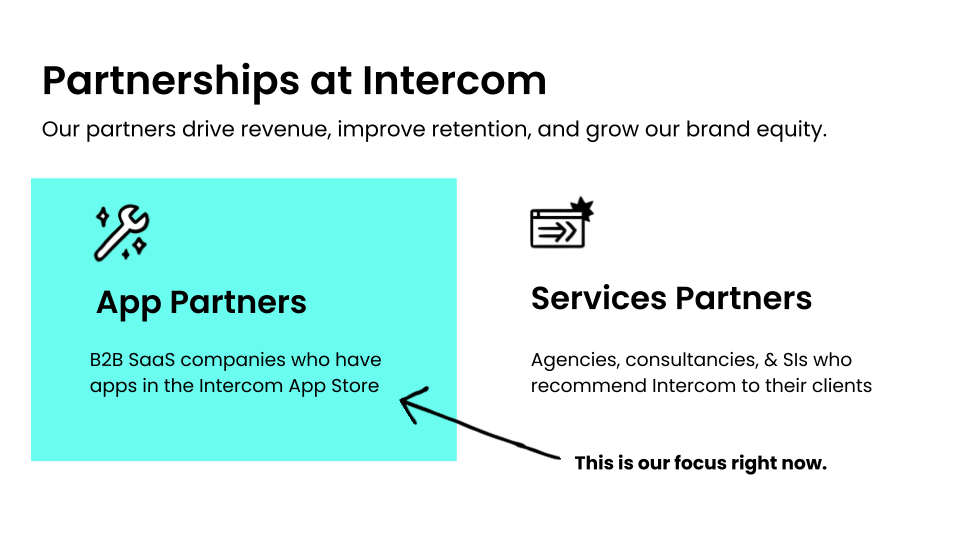
This guide focuses primarily on technology partners.
When it comes to working with technology partners, there are broadly three ways to work together.
- Partner Marketing
- Co-Selling
- Driving app or integration adoption
This guide focuses primarily on Partner Marketing tactics with B2B SaaS companies but should be helpful for any business looking to execute marketing activities with another company.
All right, enough preamble, let’s get into it.
Part 1: Build Strong Foundations
Before you develop your partner marketing strategy, I recommend that a few foundational items are in place. Of course, these can vary significantly depending on your company and stage of growth, but it’s not rocket science.
- Invest in your developer community and app ecosystem, including APIs, Webhooks, etc.
- Have established guardrails to know where to focus initial efforts.
We had much of this established by the time I joined Intercom.
App Marketplace & Developer Tools
In 2018 Intercom successfully opened up its platform to developers and launched the Intercom App Store. Not only did this provide an existing pool of partners, but it provided valuable data on app adoption amongst our customers.
At scale, these data become statistically significant, and if you have a solid reporting infrastructure, you can start to glean valuable insights. Some of the questions are basic. For example, at Intercom, we could see.
- The most popular apps
- Percentage of customers using apps
- The revenue and account health of customers using apps
- Search results in the app store
- Uninstall rates
However, you can also start to go deeper.
- What are the “tech stacks” of the most valuable customers based on ARR?
- How many integrations does it take to start to see increased LTV or retention?
- What apps are more prominent for different use cases?
Dive into as much of this information as early as possible to learn:
- Identify what product use cases or jobs are “extended” most often (in other words, where your partners add the most value)
- With what partners you may want to focus initial efforts
- The customer profile most likely to use apps and integrations
Intercom’s App Partner Program
When I joined in late 2019, we were just launching our App Partner Program – an “official” program with various partner tiers and benefits.
If you don’t have a program, that’s fine, but you’ll still need to find a systematic way to identify your top-priority partners.
This program was a crucial step because it provided the framework needed to evaluate and “tier” partners on specific criteria.
At Intercom, we landed on three tiers, the first two being based chiefly on app adoption (# of installs), and the final tier is a more “strategic” level. In essence, it was a barometer to answer the question, “should we invest in marketing with this company?” There is a lot of nuance to this, but in general, these are the key things we looked at:
- Strong joint value proposition – Does using this company’s product alongside ours provide incremental value. I use the phrase “1+1=3”
- ICP alignment – Does this company sell to the same or complimentary buyers. This isn’t a “make or break” but it’s important to make sure the marketing and sales motions are focused on the right personas. For example, there is a significant overlap between customer lifecycle marketing and customer support. …
- Capable sales and marketing teams – Do these teams have the resources and headcount necessary to execute the campaigns we are developing?
- Sales motions – Do we have complimentary sales motions? Are they the same length? Are our mutual customers buying us at the same time or at different points in their life cycles?
- Regional focus or penetration – Does this partner have penetration into a market we’re looking to break into?
- Existing product adoption – Are your customers already using you and the partners’ products together?
Once you have your guardrails in place, it becomes relatively easy to do some research and identify that short list of companies you want to start working with.
Part 2: Building a Strategy
Before you ever work on campaigns, it’s important to develop a strategy, even if it’s something basic. In some instances, it may simply mean building out internal processes to execute this type of marketing. This was one of the first things I did at Intercom.
A good strategy should answer the following questions:
- What are our North Star metrics?
- Who will we be working with?
- What teams will be involved in executing these campaigns and how do they operate?
- How will we work with those teams, and who is responsible for the various execution components?
- What type of internal enablement materials do we require?
- What types of activities will we do?
- How will we measure success?
There were some other items I had to consider at Intercom based on our App Partner Program.
- How will we field and evaluate proposed marketing activities from our partners?
- How will we surface Intercom-led initiatives to our partners?
- How will the partnerships team align our marketing goals with those of the other internal marketing teams?
- How will we actually execute these campaigns?
Since we were starting from scratch, we did not have our own budgets nor did we have our own headcount. This means we would effectively need to lean on other teams to help us actually get shit out the door, and that meant we needed to ensure that what we proposed and ultimately executed aligned with those other teams. We also needed to make sure that our planning and execution processes aligned with the other teams.
To provide more color, I’ll answer the questions above based on what I did at Intercom.
Setting North Star Metrics
Our North Star Metrics were:
- New business and expansion revenue from partner referrals or in deals where partners had a significant impact – Specifically: # of opportunities, opportunity revenue, # of closed-won deals, closed-won revenue.
- “Leads” from co-marketing activities – The most important were MQLs and what we call S1s, although new leads or “net new contacts” were also important. Note! If you’re looking at more TOFU metrics like leads or contacts, you should also make sure to evaluate the conversion rates of that funnel. For example, just because your joint partners webinar generated 2x more leads, it doesn’t mean those leads will continue to convert at similar rates to leads generated from non partner-events.
- App Usage – At Intercom we identified that when customers started to use X number of apps or integrations, we saw positive results in terms of higher ACV, better logo retention, and reduced churn.
- “Brand lift” – this is not something we were measuring in a detailed way when I started, but it’s important to remember that overall brand awareness is an important metric to keep an eye on. Just because the event may not generate leads doesn’t mean it shouldn’t be considered.
Here is a slide from an executive overview deck where I outlined our initial, “top-level” goals for partner marketing.

Determining Who To Work With
You will not be able to work with everyone, so don’t try.
The key is to:
- Identify your priority partners based on internal company goals and GTM strategies
- Determine how you will work with those partners
- Reserve the majority of your resources to work with these partners
I mentioned this above, but we had defined “tiers” of partners which provided the necessary framework for initially prioritizing who to work with. For us it was our “Premier App Partners” as well as some other partners in the program that showed strong alignment with our product as well as alignment within our GTM strategies and ICPs.
Obviously, who you work with is going to greatly depend on your overall goals. At Intercom, I looked at the short list of prioritized partners and then determined what category of activities made the most sense.
Some partners we were only going to co-sell with. Others we would only focus on demand generation-type partner marketing. Some were a combination of both, whereas others it made more sense to focus on brand-level campaigns to continue to establish ourselves as thought leaders.
Internal Alignment
Our partnerships team was relying on resources from other internal marketing teams. That meant we needed to get them to see the value of partnerships and buy into what we were doing. Ask yourself, how will this help their team crush their goals? We did a number of internal `roadshows’ to showcase the value partnerships could bring to different teams, which was instrumental in getting buy-in.
As part of this, I needed to understand their strategies, planning and execution process.
You need to understand how those teams function on a day to day and quarterly planning level. Once you know this, you should build your processes to align.
Develop Internal Processes
Once I had an understanding of how those teams operated I was able to craft our own processes to align. The most important aspects were:
- Knowing when I needed to start having quarterly planning meetings with partners
- What themes, topics, and audiences were in-bounds
- How many events or activities we were able to commit to
My process was relatively straight forward:
- Set meetings with internal teams to understand their goals and capacity for the quarter
- Align on what resources we could make available
- See where partners could amplify existing / already planned efforts
- Set meetings with key partners to
- Learn their goals for the quarter
- Relay our goals for the quarter
- Align on potential areas we could work on
- Take tons of notes and later organize them
- Prioritize what we could do based on the overall marketing and company goals and then rank activities based on the potential impact and relative lift
- Come up with a final list of propose (and ranked) activities
- Share internally to get buy-in and alignment, adjust the list accordingly
- Meet with partners again (or do it a-sync) and align on commitment
- Set the quarterly plan in motion
Note: Make sure to build a buffer into your capacity. Some things will get postponed and things will come up last minute. Don’t set your plans assuming you’ll be at 100% efficiency. In other words, if you think you can execute 6 webinars in a quarter, plan 4.
I did this exact process with our field marketing team, since it was one of the most successful partner marketing motions we developed. Here are some slides pulled from that deck:


In the beginning this was much more difficult since we didn’t have any concrete data on what was or wasn’t working. It was one of the reasons I needed to do a lot of experimentation – and fast – so I could come back with wins for those teams to prove value.
Create necessary enablement materials
In retrospect, we did a great job developing key internal enablement resources our teams could self-serve and use. Some of those included:
- An internal database of all our partners with company and integration information
- Joint messaging documents for key partners
- A co-marketing hub to track all our ongoing partner campaigns
- Basic enablement decks on our top partners
- A place to find existing customer evidence relating to our partners
Joint messaging documents were a key foundational asset for us, and wound up being much more useful than I initially anticipated. This slide is from a deck where I explained what they are.

Here is a screenshot of part of our joint messaging document with Dialpad.

Partner overview decks were useful primarily for sales, but also used often in marketing campaigns or for internal education on partners.

Here’s a slide we made for our sales team about Aircall.

Here is a screenshot of the Partner Marketing Hub I created in Coda to track and measure all of our partner marketing efforts as well as act as a source of truth for all of our internal enablement materials. If you want to learn more about this Coda hub, check out the case study they created.


Know what tools are in your toolbox
At Intercom we typically divided our campaigns into three categories. Marketing-focused, Sales-focused, or Hybrid events that may involve a bit of both.

These were the teams I’d be working with most of the time when executing marketing campaigns with partners, along with the various types of activities.
- Field Marketing – Field events and webinars
- Social Media – Varied greatly, but spanned product announcements, general campaigns, content promotion, and more.
- Content Marketing – Blog posts and gated content (ex: guides and books)
- Product Marketing – Product launches and app launches
- Lifecycle Marketing – Ongoing campaigns to existing customers
- ABM / Outbound – Outbound email demand generation campaigns
Measuring Success
I can’t emphasize how important it is to be able to track the success of these campaigns.
If you’re just starting out, get something in place that can tell you the success of an individual campaign or activity. As you grow and see success you can get more sophisticated and start attributing revenue to your campaigns.
From the get-go, you should be able to confidently show with data, that:
- Your partner marketing campaigns are performing at least as good as your normal campaigns and at a comparable cost. Are you partner webinars generating more attendees than your normal ones?
- The promotional activities that are driving that success for those campaigns. Is it your email campaigns or social media posts driving registration to your webinar?
As you get more sophisticated, you should also be able to validate that:
- The leads from these activities are converting as well or better than other leads.This is important! If you’re generating 2x leads but they’re not converting, then you may not be getting in front of the right people.
- These campaigns are generating revenue.
If you have more resources, I highly recommend setting up dashboards that evaluate your partner marketing campaigns like any other marketing campaign. Revenue is the most important thing to be able to track to your campaigns, so even though it might be an arduous process getting the tracking and attribution set up, you should do it. Not only will it help direct where your time should be spent, it will help get more internal buy-in for what you’re doing.
Campaign Tracking
At Intercom, we worked with our Marketing Ops team to develop a campaign naming structure that fit into the existing systems we had. This allowed us to track all the necessary pieces of information to evaluate success and hone our strategy.
Here is an example of a partner webinar we did in NAMER.
20211103_WB_EMEA_AWS_Heap_WebinarComponents:
- 20211103 – The full date starting with year, month, and day
- WB – Our code for “webinar”
- EMEA – The region the campaign takes place
- AWS_Heap_Webinar – The name of the campaign which always included the partner
This lets us evaluate the partner campaigns in the exact same way we did all our other campaigns, making dashboard setup much easier and reporting more frictionless.
UTM Tracking
We also use UTM URLs for all of our promotional activities. Again, I can’t stress how important this is. You need to know what activities are driving success. I’ve found that most of the time email campaigns and any kind of in-app messages drive the most success. However, sometimes you’ll get a surprise and can learn something new.
From that same example above, I used a UTM URL when I shared a link to the webinar on LinkedIn. Because I tracked it, I learned that a single post generated 106 registrations representing 68 different companies, all of which were net new contacts.
You don’t need to be crazy with your system! Just follow the best practices. The most important things are:
- Campaign Source (ex: LinkedIn)
- Medium (Mark’s Post)
- Campaign Name (Ex: Partner Webinar X)
You also want to be able to figure out which results came from a partner or group of partner. This is where you may want to get creative. For example, I can set the Medium as “Partner LinkedIn Post” to know thoise RSVPs came from them.
The number of UTM urls and how you structure them generally will depend heavily on the type of campaign. Sometimes you just need to share one UTM URL for each partner since they are all doing the same activity (ex: a tweet). Other times you may want to send three UTM URLs to a single URL if they are doing three different activities. Other times I’ve simply created a catchall UTM URL I used for all partner support.
For these UTM URLs, we typically use the system below, however you don’t need to be that sophisticated to start. It’s important to be able to track what specific activity or tactic drove your result.
- Campaign Name – The campaign according to your own naming conventions
- Asset URL – The destination URL
- Channel – This can vary.
- Date – Campaign date
- Campaign Type – The campaign type
- Partner Name – The name of the specific partner your working with
Meet with your key partners
At this point you probably already have some relationship with them, but if not, I’d suggest setting up a 60-90 minute meeting where you can align on mutual goals, processes, as well as talk about what type of campaigns you may want to run.
Depending on how much you have worked together, it may also make sense to do some basic enablement. Treat it as a training session on your product and offering, and they can do the same.
Here is a screenshot of an older agenda we used when doing kickoff calls with our strategic partners once they joined our program.

Part 3: Types of Partner Marketing Campaigns
I find there are generally three types of partner marketing campaigns.
- Led by your company
- Led by the partner
- Jointly-led
Here is a slide I pulled from the deck I created to detail the partner marketing webinar process. This slide puts the above through the lens of webinars, but you can apply it to any other form of marketing (content, social, etc.).

Led by your company
These are initiatives that your company is driving that you think could benefit from partner support, or that you would like to include partners somehow. Most of the work is going to be done by your teams, and partners will be included in some way.
An example at Intercom was our “Support Landscape” Interview Series looking at how modern support leaders were navigating the support landscape as it continues to evolve. This was driven by our content team, and I helped facilitate getting a few of our strategic partners involved.
Here is a link to one of the articles featuring Slack.

Here’s another example where we brought on Francis Brero – Co-founder and CRO of MadKudu – onto our podcast.

Led by the partner
Similar to the one above, but led by the partner. They’re doing something and want to include you in it. Most of the work will be done by the partner, and you’re getting to go along for the ride.
Here’s an example where we took part in Productboard’s ongoing series where they talk to product leaders about specific product launches. In this campaign, we contributed Jane Honey’s time and insights to Productboard, who took care of all the organization, editing, and promotion of the final blog post.
Jointly-led
These are campaigns or activities that are proactively planned between your teams, and where the workload is more equally shared. They usually take a lot more lead time and therefore should be planned in advance whenever possible.
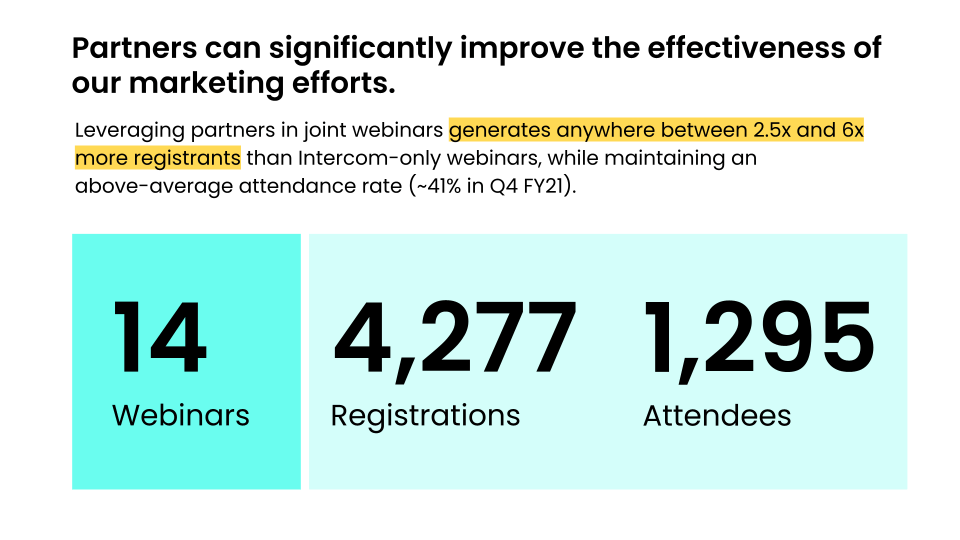
During the pandemic, we saw a lot of success with joint webinars with partners that would feature a mutual customer. It’s difficult to split the work 50/50 exactly, but the real goal is to make sure everyone is pulling their weight and has skin in the game.
Intercom, Heap, and AWS Webinar
We did one webinar along with Heap and Amazon that featured a mutual customer, Simple Texting.

This joint webinar was driven equally by Intercom and Heap and included full lead sharing. We generated 1,097 registrations and had 581 attendees (a 53% attendance rate).
Klaus & Intercom’s Customer Service Quality Benchmark Report
In 2020 Klaus and Intercom worked with Support Driven to survey customer support and success leaders on topics like quality metrics, quality assurance processes, and team setup. We then compiled those findings into a gated report called the “Customer Service Quality Benchmark Report” and executed a number of GTM activities to drive report downloads as well as put on a webinar to review the results.
The report was a huge success, generating 500+ downloads in the first 3 months alone. It was so successful, in fact, we got internal buy-in from our marketing teams to update and refresh the report annually.
We updated the report in 2022, and saw even better numbers than the initial release.

Part 4: Fielding, Proposing, and Executing Campaigns
There are two very broad types of partner marketing campaigns: Planned and “Ad-Hoc”. In other words, some campaigns you deliberately plan in advance and resource for, whereas others pop-up here and there.
The key is not to eliminate ad-hoc opportunities, but you want to ensure the majority of your time and energy are spent on pre-planned activities, since those are usually the most impactful.
Here are some slides from the deck I created detailing the initial partner marketing strategy we implemented at Intercom.
Initially, most of our partner marketing was ad-hoc.

A core part of the strategy was to shift resources to more well thought out campaigns we could plan in advance.


Generally, you want a clear set of criteria and processes for executing all of these campaign types.
- How do you field inbound opportunities from partners?
- How do you bring internal opportunities to partners?
- How do you ideate joint campaigns?
- How do you pitch those campaigns internally?
Below I got into more detail as to how we did that at intercom.
Regardless of the campaign type or who is driving it, I found just about every activity involving partners benefitted from some kind of basic “campaign brief”. It’s really simple and you don’t need to make this fancy. It should include:
- What is this opportunity?
- What is the goal?
- What is the level of involvement for the parties involved?
- When is it happening?
- What are the specific next steps?
- Any other basic/required information (ex: assets, messaging, pre-drafted copy, etc.)
Here is an example of a brief I made for our partners we invited to be part of our Intercom-led “Support Tech Stack” content campaign. It details the campaign overview, timeline, commitments, as well as tentative interview questions and next steps. The goal is to make sure you, your internal marketing teams, and external partner stakeholders are on the same page.

If your campaign is about a product launch, I found it’s also good to provide the following information:
- Product messaging
- Existing product assets (GIFs, screenshots, videos, etc.)
- How it impacts the partner or benefits them and their customers
- Release timeline
- UTM Tracked URL for sharing
- Suggested announcement copy (Make it super easy for them)
For these, I recommend kicking off discussions very early, and then bump the partners 2 weeks out, 1 week out, and then the day before or early the day-of.
Fielding External Opportunities
You’ll never totally get rid of last minute opportunities from partners, and you don’t want to! Sometimes these can be fantastic. I recommend allocating 25% of your resources of bandwidth to these types of campaigns, although early in your partner marketing journey that number may be higher.
Here is a slide from my initial strategy deck detailing how we would field these external opportunities. In short, some of our App Partners could submit inbound requests through forms that would go directly to teams who would evaluate and then make a decision. Some partners submitted those ideas to Me and the Partnerships Team, who would then filter them and bring them to the respective teams. If we wanted to move on one of those, we would connect the relevant teams and kick off more detailed planning.

“Our strategy is twofold: reduce these requests by shifting opportunities that are currently ad-hoc to being proactively planned; and screen inbound requests so the right opportunities get to the right teams.”
Bringing Internal Opportunities to Partners
We also needed a process to bring opportunities to our partners.

“It’s important to note that we don’t want to be a roadblock. We want to enable the teams to research and propose ideas while staying in the loop. In addition to the resource library, we’ll educate internal teams with a one-off partner roadshow. After that, we’ll set recurring syncs to keep teams up to date on what’s going on with our top partners. “
How to ideate joint campaigns
This is no different from brainstorming normal marketing campaigns, but you’re including a partner (or partners) and your theme or narrative will be tied to your mutual joint value proposition.
Sometimes I would brainstorm on my own, and then bring the ideas to partners before honing them and pitching them internally. Other times I would brainstorm with partners on calls. Regardless, you’re only limited by your imagination.
Once you come up with something, I recommend creating a campaign brief that can be leveraged by the marketing teams at both companies. Once that’s ready, both you and your partner will need to pitch the idea internally. Once you get general buy-in, then it’s usually a good call to set up a kick off meeting to align all the relevant stakeholders, answer outstanding questions, and then set a clear DACI with roles and responsibilities.
From there, it’s just like executing any other marketing campaign.
How to pitch joint campaigns internally
My advice here is simple – make sure you clearly define how this campaign will benefit the internal team(s), and be clear with what the campaign and its goals are. Generally:
- Better to over communicate since partner marketing motions are often new for people
- Be prepared to explain what partners are \or what they’re generally valuable to your campaign
- Expect to get questions about what your partner does or how the integration works
You may need to do some additional work in order to get some ideas across the finish line. Don’t be afraid to get your hands dirty.
“We don’t have the bandwidth to develop a deck and talk track, sorry Mark.” “Don’t worry, I already created it!”
It’s really tough to push back when you’ve teed-up a big win for an internal team.
Part 5: Start to Experiment
Depending on who you are, this might be the fun part or a nightmare.
Just like with traditional B2B marketing, there will be no shortage of ideas, tactics, and strategies you can employ. The million dollar question is what should you start with?
Determining Where to Start
As always, start with your overall goals. Is your focus on driving app or product adoption? Is it generating free trials? Referral revenue? Lead generation? Try and hone in on a key area to start with.
Before you even begin to work on these experiments, you will want to make sure you are set up to properly track and measure the success of your campaigns. I can’t stress this enough. Get a system in place before you kick things off. It doesn’t need to be crazy sophisticated, but you should be able to use data to evaluate whether or not a campaign was a success.
At Intercom, we had three broad area goals we were trying to achieve.
- Referral revenue – This was revenue we could attribute to partners, most within sales referrals. This also includes revenue we can attribute to partner marketing activities.
- Lead generation – Net new contacts, MQLs, SQLs, Opportunities, etc.
- Product adoption – We looked at various metrics. On the app level, the number of active installs, ARR of the install base, and Platform Active Customers (those with a set number of apps installed in a workspace).
Brainstorming Partner Marketing Activities
I found it useful to just brainstorm as many ideas as possible and bucket those into various GTM “categories” along with what KPI they tie to. Take inspiration from what your existing marketing team does and what you see in the market.
| Activity | Goal | KPIs |
|---|---|---|
| Product launches | Product Adoption | # workspaces using feature |
| App launches | App Adoption | # Installs |
| Social Campaigns | Brand awareness | Reach / Impressions |
| Joint Customer Stories | Brand awareness | Pageviews, Time on Page |
| Virtual events | Demand Generation | # MQLs, Attributed Revenue |
| Webinars | Demand Generation | # MQLs, Attributed Revenue |
| Conferences | Demand Generation | # MQLs, Attributed Revenue |
| In-Person Events | Demand Generation | Attendees, Attributed Revenue |
| Sales Meet & Greets | Sales Referrals | # Referrals; Attributed Revenue |
| Email campaigns | Demand Generation | # MQLs, Attributed Revenue |
| eBooks and Guides | Demand Generation | # MQLs, Attributed Revenue |
| Guest blog posts | Brand awareness | Pageviews, Time on Page |
| Joint themed campaigns | Demand Generation | # MQLs, Attributed Revenue |
| Sales enablement sessions | Sales Referrals | # Referrals; Attributed Revenue |
| Podcast episodes | Brand awareness | Listens/Downloads |
You’ll start to notice as you make this list, some activities are much more tangible than others. For example, it’s clear what a joint virtual webinar is, but “joint themed campaigns” might seem more nebulous. That’s fine, just keep brainstorming.
You’ll also notice that many of these campaigns may have more than one potential goal or KPI. For example, a joint webinar may serve to generate net new leads, but it can also be marketed to existing prospects and customers. That means you should look out for:
- Net new contacts/leads from the campaign – These are the brand new contacts you can attribute to this campaign
- Pipeline acceleration – Was your campaign successful in converting leads to MQLs? Maybe MQLs to opportunities?
- Influenced revenue – Your campaign may have some directly attributed revenue to it.
Many of these tactics can be bundled together to execute broader “campaigns.” I’m a big believer in executing more thought-out, long-term campaigns that have multiple marketing events within them. They often take the same amount of effort and yield much better results.
At Intercom, we had a number of tools in our toolbox, most of which I outlined above. The activities below were some I decided to start experimenting with (I also included some general findings). Start with things you know how to do and then iterate and get more sophisticated.
Product Launches
Getting support to amplify a product launch seemed like a no-brainer, and we did see some success, but I also found that most of the time “the juice wasn’t worth the squeeze.” The lift we would see from partner involvement often didn’t justify the number of hours that went into planning. I’d say do this if it’s a big launch, and if the partners are going to see a direct benefit from what you’re bringing to marketing.
Social Campaigns
These can be great for general awareness and brand lift, but they often do not translate into clicks or any kind of lead generation.
Content
Three types of content marketing worked well forus.
- Joint Customer Stories – It’s always great to have more customer evidence, and these can be repurposed into a number of other assets.
- Guest Blog Posts – Intercom has an amazing blog and content team behind it. Guest blog posts were a relatively easy way to insert partners into an already well-established marketing machine that provided a lot of real exposure and value for our partners.
- Gated content – These are the epitome of “high effort, high reward” when done right. As with joint customer stories, the content can be repurposed time and time again, especially if it’s evergreen.
Webinars
Webinars wound up being one of the best joint campaign types we invested in. They can be hit or miss, but if you do them right, you can see some amazing results. I will go into more detail about these later on.
Remember some things drive much more value than you think! Two example:
- The Intercom changelog gets a ton of traffic, so I wound up using this to highlight new apps in our app store.
- Our New & Noteworthy collection in our app store was a high-traffic area in our app store, so we added inclusion in this as a benefit for our partners when they entered the program.
I recommend starting with what you know already works for you and your team, and then loop in a partner.
This slide is from an executive summary deck where I laid out everything we tried in FY21 during our “experimentation” phase.

Tracking Your Campaigns
You need to be tracking your campaigns. There are a few reasons:
- You’ll need a source of truth just to keep everything organized for yourself. Trust me it gets messy quickly.
- There will be a lot of cross-functional internal collaboration and having a single source of truth helps a lot.
- It provides transparency to your cross-functional teams and leadership.
- You’ll be able to reference it later to evaluate results, find the final product of your campaigns, see how many campaigns you’ve done, etc.
I suggest using whatever software your team is already using. For us, that was Coda (more on that below).
Part 6: Lessons Learned
We learned a lot launching our initial strategy and experimenting with a lot of different types of campaigns and partners.
Intercom-Specific Learnings
Here are some of the key takeaways, taken directly from the executive summary I presented after our first year of executing partner marketing.

Practical Learnings of Note
Outside of these Intercom-centric business takeaways, we learned a ton of practical, tactical knowledge as well.
On Partner Marketing Campaigns
- Webinars worked very well and were often easy to get started with because there already existed solid processes and frameworks to execute at both companies. Additionally, those with mutual customers performed the best.
- Including partners in product launches can be a great tactic to drive product awareness, but it’s often “high light, low reward” outside of general awareness. These should be restricted to specific, high-value launches and include partners that will see a direct positive benefit from the launch.
- Contents and guides, especially blog posts and gated content, can be huge. See below for an example we do with Klaus.
- Creating joint customer stories sounds straightforward, but it often requires way more time and coordination than people realize. That being said, getting a great joint customer story is massively valuable, and can be turned into a number of other assets like blog posts, pitch deck slides, business claims and quotes, webinars, and more.
- Generally it’s a good idea to keep a running list of mutual customers with your key partners you can tap into.
- Do the same thing for internal speakers. If you find someone willing and able to speak during a webinar or events, keep them happy and show them you appreciate the hard work.
- You may need to show smaller successes early on in order to get buy-in for larger projects. That’s fine, it’s ok to start small, just make sure you’re measuring success and can show a positive ROI.
- Full lead sharing is best whenever possible. This aligns incentives and you can hold each other accountable using UTM URLs.
- Take the amount of time you think it will take to execute a campaign and double it.
- Virtual event fatigue is a thing, but you can get around it.
- If you have the budget, paid incentives like “Sign up and attend to get a $20 Amazon Gift Card” can work wonders to cut through the noise.
- Execs and thought leaders at your company can help drive attendance.
On Selecting Partners to Work With
- Build great relationships with the people you’ll be working with. I had the privilege of working with countless smart, hard-working, and respectful people which made the job an absolute pleasure.
- Some partners are good at specific tactics and your strategy should take that into account. For example, one partner may have a fantastic content machine whereas another is known for webinars.
- Just because a company is big, doesn’t mean they have their shit together.
- Just because a company is small, doesn’t mean they can’t have a big impact. The most important things to keep in mind are:
- Do they sell to the same types of companies and buyers?
- Do they have a marketing and/or sales organization that is mature enough to handle the effort, and are they willing to put in the work? I’ve found often that smaller companies are more eager and willing to work with you, and they’re scrappy. They focus on the things that make an impact and not vanity metrics or checking boxes.
- Smaller or less well-known brands can often get larger brands to engage with them if you can find opportunities that either:
- Provide value to that individual at that larger org (ex: helping them build their personal brand)
- Have very little lift and high reward (ex: interviewing someone for our podcast often took little time for partners, but provided significant reach and exposure)
- The campaign helps that larger partner break into a new market or use case in which you, the smaller company, is a thought-leader.
- Be clear and direct upfront and over communicate when it comes to who owns what. Stop and think about how hectic your own company can be when it comes to communication, now compound that with working with an external partner with multiple teams… It can get messy.
On Internal Enablement
- A living and breathing joint messaging document that details information about you, your partner, integration, and joint value prop will come in handy time and time again. Even if no one except you ever uses it, I promise it will come in handy when creating other assets like landing pages, email campaigns, decks, and more.
- Executing an internal roadshow should be on your list. I’d recommend doing this for both sales as well as internal marketing teams. Detail who your partners are, the value they bring to the company, how the apps or integrations generally drive value, and most important, how the various internal marketing teams can benefit from and leverage partners to achieve their own goals.
- Crossbeam is a tool we started using relatively recently at Intercom that can expose overlap in your customer and prospect lists with other companies in a way that’s secure and compliant with various privacy laws. This is mainly useful for sales, but I noticed it’s great for helping to find mutual customers as well (I’m a big fan if you can’t tell).
- Creating internal enablement materials is just the start! Make sure to have a distribution plan to get them in front of the right people and teams, and implement tracking where you can to make sure they are being used.
Part 7: Scaling what works
If you have the right tracking in place, this is where things get really exciting. Once you start to experiment you’ll have qualitative and quantitative data to back up what is or isn’t working. Review your results, and select a few campaign types to replicate.
- What types of campaigns performed well?
- What audiences were those geared towards?
- What partners did you see the most success with?
- Which teams were you working with internally to make those campaigns happen?
- What type of promotional activities did you do that worked well?
From here it’s about showing the positive results and doubling down on what worked.
Did you have a successful webinar with a partner and mutual customer? Great, do 3 more next quarter with different partners and see if the success is replicable.
Did that email campaign fall flat? Maybe table that for another time when you can tweak and experiment again.
Once you can show executives that your partner marketing efforts are effective, you should be able to argue for more resources. Initially this investment can take various forms:
- A general “decree” to do more work with partners from leadership
- Existing internal marketing teams may allocate some of their resources to partner marketing efforts
- Additional budget may be allocated to those teams to use specifically for partner-related campaigns
- You may start to see your own budget to spend on partner marketing campaigns
Eventually you can make the argument to hire dedicated partner marketing roles and gain control over your own budget. Depending on your marketing org structure, these new hires may be dedicated to partnerships and sit on a separate “partner marketing” team.
Let’s take Field Marketing as an example.
Option 1: Partner Marketing is its own org (often under Demand Gen).
In this case you may hire one Partner Field Marketing Manager in EMA and one in NAMER. Both report directly to you and focus solely on partners. They often work with one or more Partner Managers with an existing book of business (re: partners) and have their own DG targets.
Option 2: Partner Marketing works more closely with internal marketing teams and share resources.
In this case, the Field Marketing team may hire those two new Field Marketing Managers who will focus on partner campaigns. Their scope is partner-specific, but they sit on the normal Field Marketing team.
Final Thoughts
If you feel like you have no idea what to do or where to start, you’re not alone. Partner Marketing is a relatively new motion for a lot of people and companies. Roll-up your sleeves and don’t be afraid to get your hands dirty.
Set a solid foundation and get buy-in from leadership and your internal cross-functional teams as early as possible. This includes deciding who you will work with.
Experiment, learn, and be data-driven. That’s the only way to really know if what you’re doing is working, and eventually, to get buy-in from leadership.
Once you figure out what works, double down on your best performers, but don’t be afraid to keep experimenting or even revisit previous ideas.
Refresh your strategy, processes, and tactics as needed! Your company is living and breathing, so should your partner marketing strategy.
Set a high bar, work hard, keep pushing, and don’t be too hard on yourself.
You’re smart, you’ve got this, and you’re gonna’ fucking crush it.
Cheers,
Mark
 The Partner Marketing Guide